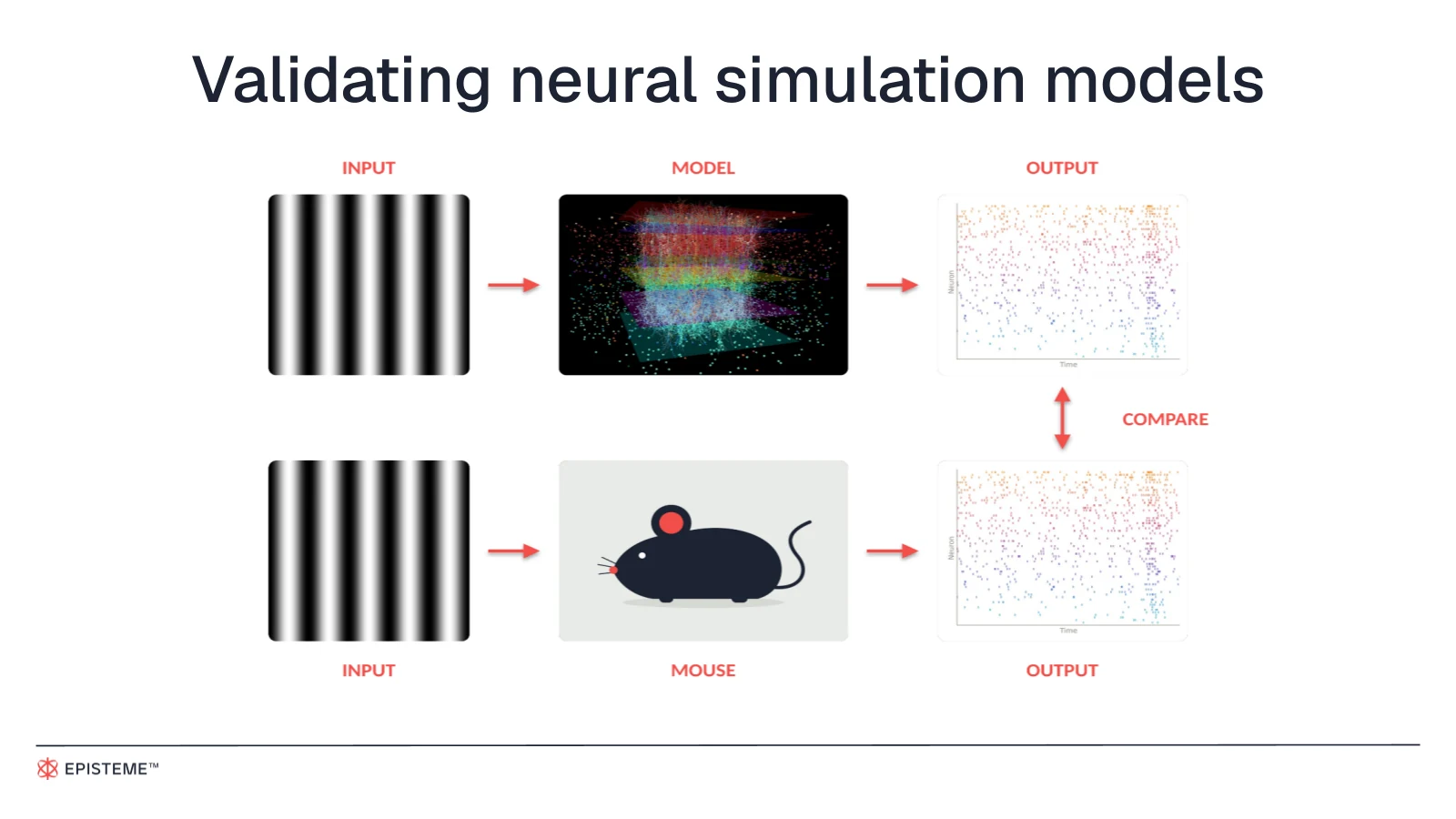
A neural model is tested by running the same experiment on an organism and in software
Episteme, co-founded by Louis Andre and Sam Altman, describes itself as a new kind of research and development institution whose model draws on Bell Labs, the Institute for Advanced Study and Xerox PARC.
Zachary Miller is a member of Episteme’s research staff working across neuroscience and AI. His neural simulation work follows a loop: run an experiment on an organism, run the corresponding experiment in a computer model, then compare the outputs to see which features of the real experiment the model captures. His pilot project used an existing Allen Institute neural model.
Each comparison depends on the stimulus, simulation configuration and analysis describing the experiment the scientist intended to run. Miller’s project attacked both the software bottleneck in running simulations and the difficulty of supervising agents doing scientific work. He argued that current models already had the intelligence to test a model against the literature; the missing piece was infrastructure, a shared record detailed enough for a scientist to understand an agent’s work and decide whether to trust its outputs.
The refactor took two days and weekly simulations reached the hundreds
- Weekly simulations rose from roughly 12 to hundreds. At Demo Day, Miller reported running hundreds of neural simulation experiments a week, up from roughly 12, after a software refactor he had estimated at about a month took two days.
-
About 400 claims were extracted across papers. Miller had separated the literature search from a second pass that checked claims against the simulator’s capabilities, extracting about 400 claims. Because the model lacked mechanisms for plasticity, the changes in neural behavior associated with learning and adaptation, papers depending on a change over several days needed to be filtered out of the immediate test set.
-
Supervision moved from chat into shared files. Miller required agents to work through plain-text Markdown files in which SPEC.md describes the task, PLAN.md organizes the work, STATE.md preserves its current state, DECISIONS.md records choices and RESULT.md captures the outcome. “Most of my time is reading and editing these files,” he said at Demo Day.
-
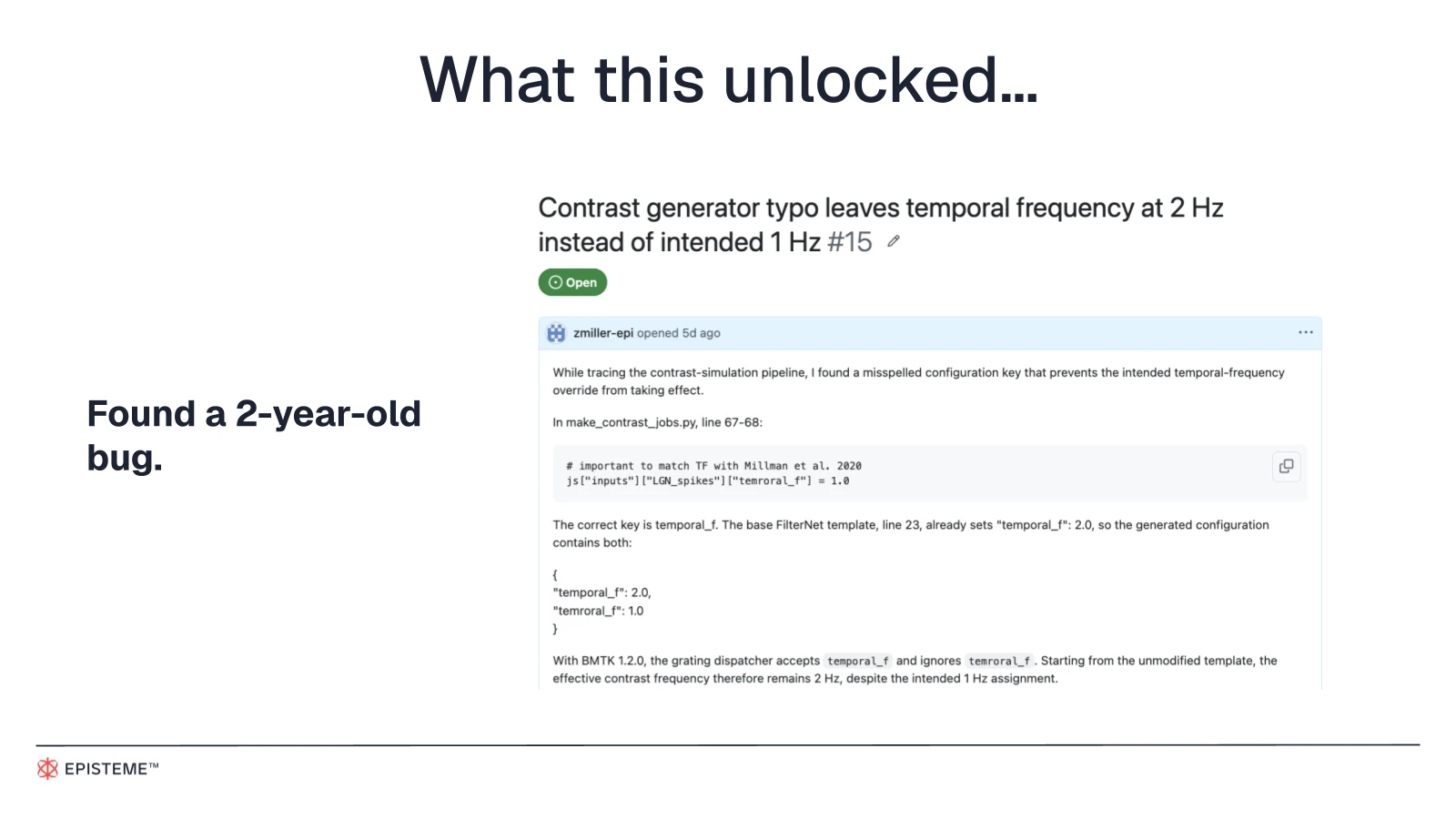
Miller found a two-year-old stimulus bug. In a contrast-stimulation pipeline, a misspelled parameter name meant the simulator ignored an instruction to set a visual stimulus’s temporal frequency to 1 Hz and kept the template’s 2 Hz setting. Miller reported that the bug had been present for two years and documented it publicly.
-
Morning ideas became afternoon prototypes. On multiple occasions, an idea discussed in the morning had become a prototype by the afternoon, giving colleagues something executable to inspect. As Miller put it at Demo Day, “we actually just send each other prototypes.”
-
Miller announced an open-source release. At Demo Day, he said the agentic-campaign-workflow toolkit was being open-sourced and invited other researchers to use it, change it and customize it. Today, the toolkit was public, with a tutorial using a basic linear-regression example in preparation.
Next, agents would test a neural model against published experiments
Miller’s larger objective is to have an agent find the experimental results in the literature relevant to a model, test them and report both the matches and the failures. The test is whether an agent can carry experimental conditions faithfully from a paper into a simulation, then distinguish an implementation mistake from a biological phenomenon the model cannot explain.
The roadmap he presented included an interface for auditing how agents use individual notebook files and lines, a research brain that draws context from Zotero and Slack, and lower token costs. Miller pitched the workflow as a starting point for scientists whose AI work remains inside chat, and he invited researchers exploring more ambitious uses of agents in science to contact him through LinkedIn.