Brain interfaces built from molecules need experiments that isolate cause
Pradeep Ramesh, PhD, is head of data science and biological machine learning at Merge Labs, which is working on brain–computer interfaces (BCIs), systems that transfer information between the brain and a device. Merge’s proposed approach connects with neurons through molecules and uses methods such as ultrasound to reach deep into the brain while avoiding implants in brain tissue. Its founding team includes BCI researchers Mikhail Shapiro, Sumner Norman and Tyson Aflalo with entrepreneurs Sam Altman, Alex Blania and Sandro Herbig. OpenAI announced its investment in Merge’s seed round in January 2026.
Ramesh described the work as spanning hardware engineering, neuroscience, systems biology and machine learning, and he told the Demo Day audience that frontier models could not solve that collection of problems in a single attempt. In a study of an engineered protein, for example, an observed response might arise from the protein or from the inducer used in the experiment; without an inducer-only control, more measurements under the same design may leave the ambiguity intact.
Ramesh developed Tenzing during Reactorfield’s Cohort 1 program, which he called a forcing function to put very limited time and bandwidth into a coherent effort on agentic science. Merge brought a problem that reaches past any single model’s ability to answer a question: how to get more useful knowledge from the next physical experiment.
Interviews with Tenzing changed three experimental designs
-
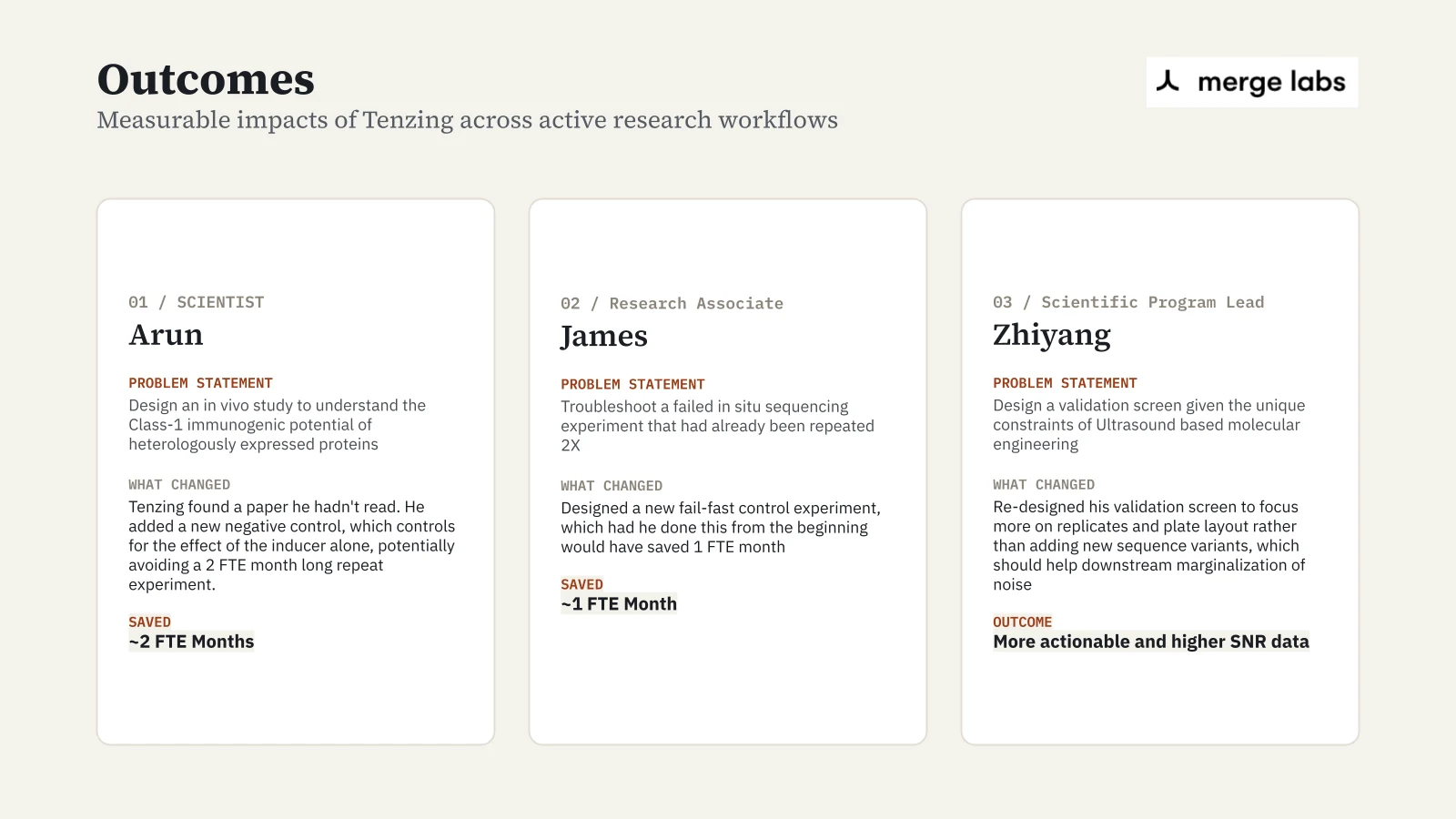
An added control could spare about two months. Scientist Arun was designing an in vivo study of the Class I immunogenic potential of heterologously expressed proteins, proteins expressed in a biological system other than their original one, when Tenzing found a paper he had not read. He added an inducer-only negative control, and Merge estimated that avoiding a repeat could spare about two months of one full-time scientist’s work.
-
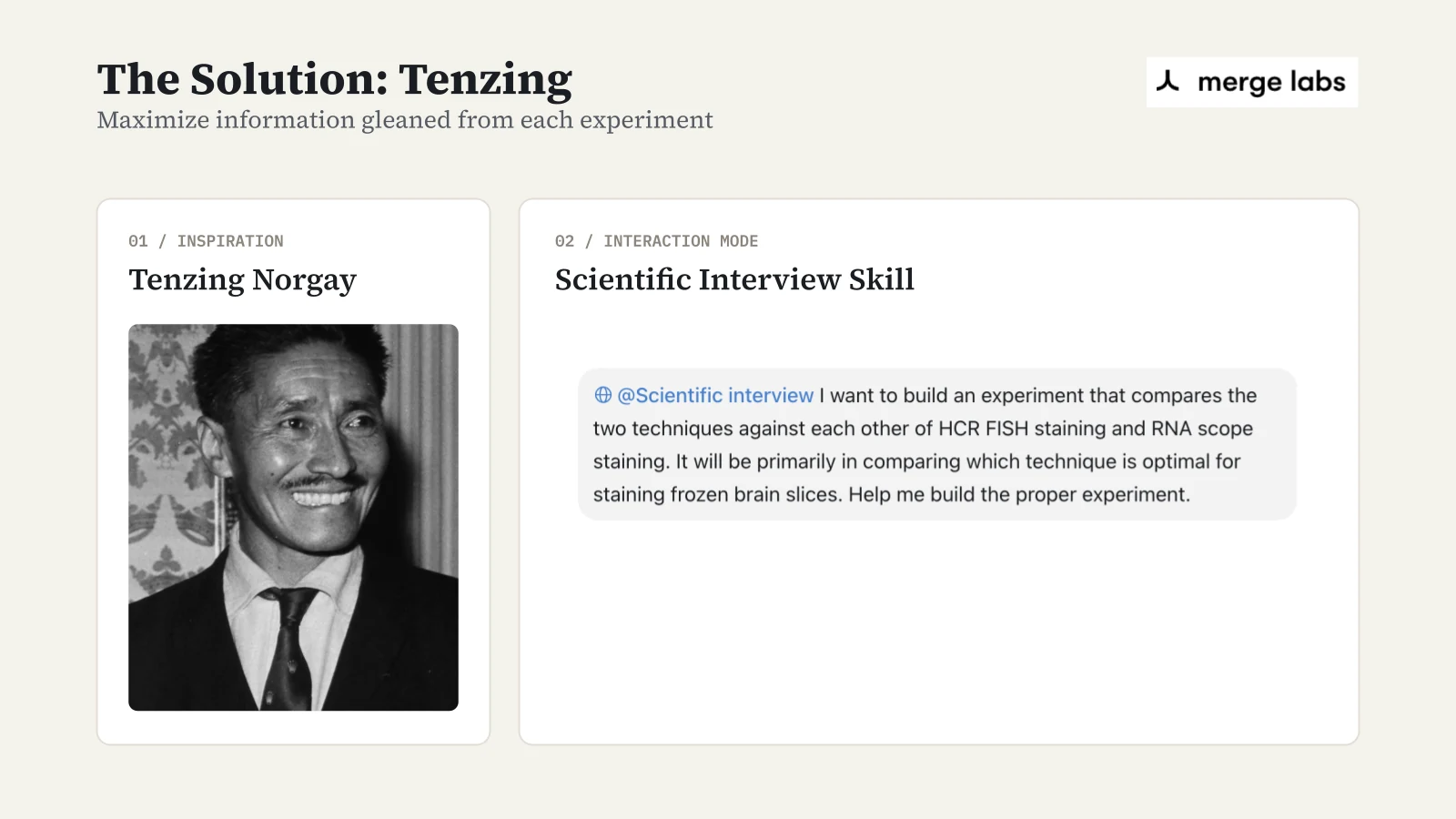
Ramesh gave Tenzing Ezra Klein’s conversational style. The name honors Tenzing Norgay, the Sherpa who was instrumental in Sir Edmund Hillary’s Everest climb, and the interviewer is meant to act as an empathetic, patient and deeply knowledgeable colleague. Ramesh aimed it at experiment planning: the scientist brings a research question and an intended experiment, and Tenzing draws out confounding variables, identifies implicit assumptions and brings in relevant literature.
-
A tester’s output recorded why decisions were made. During a Reactorfield Office Hour, a tester reported that Tenzing’s output included experimental controls, a study summary and the rationale for decisions.
-
Tenzing changed experiments in four major campaigns. In the pilot Ramesh presented at Demo Day, six scientists completed 18 sessions in workflows including immunology, sequencing and molecular engineering, and the changes came before the teams returned to the bench.
-
A twice-repeated sequencing experiment got a fail-fast control. Research associate James was troubleshooting an in situ sequencing experiment, a method for reading genetic information while preserving its location in a sample, and with Tenzing he designed a control that would expose the problem early. Merge estimated that running it from the beginning would have saved roughly one full-time-equivalent month.
-
An ultrasound screen was redesigned for stronger signal. After his interview, scientific program lead Zhiyang redesigned a validation screen for ultrasound-based molecular engineering to get a stronger signal relative to background noise. Tenzing steered the design toward replicates and plate layout rather than more sequence variants, so the statistical test would have enough power.
- Scientists caught potential mistakes with Tenzing. At the Reactorfield Cohort 1 wrap-up, Ramesh reported that trainees and scientists, including research associates planning multi-day experiments, were still catching mistakes through Tenzing, even those who already used general-purpose chat tools.
What an AI colleague at the bench means for frontier science
Ramesh has proposed a next step for the screen: a Monte Carlo simulation that uses the team’s error bars, sample sizes and library budget to compare candidate allocations under the variability the laboratory observes. Testing the redesigned screen could then help Merge decide when broader exploration of a molecular library is justified and when more replication is needed.
The time figures are Merge’s estimates of avoidable work, and Ramesh said at Demo Day that “the jury is out in terms of what kinds of savings are going to come as we roll this out to the broader company.”
Merge’s stated goal is to merge human and artificial intelligence at scale, and Ramesh argued that frontier models cannot one-shot their way there. Tenzing gives AI a different job on that path: not giving scientists an answer, but questioning their plans while the design can still change, so each costly experiment yields more. Ramesh said the “idea of using AI to help you think deeper about your problem, I think, is a really good way of trying to make progress, especially in places where you know science simply doesn’t have all the answers.”