A rejected human lung and more than 43 quintillion options
Vera Mucaj, PhD, is a Mayo Venture Partner who works on turning clinical science into companies. She previously joined Datavant as employee No. 8 and became its chief scientific officer; according to Mayo’s biography, the clinical trials business she founded there was adopted in more than 250 trials by most of the top 20 pharma and biotech companies.
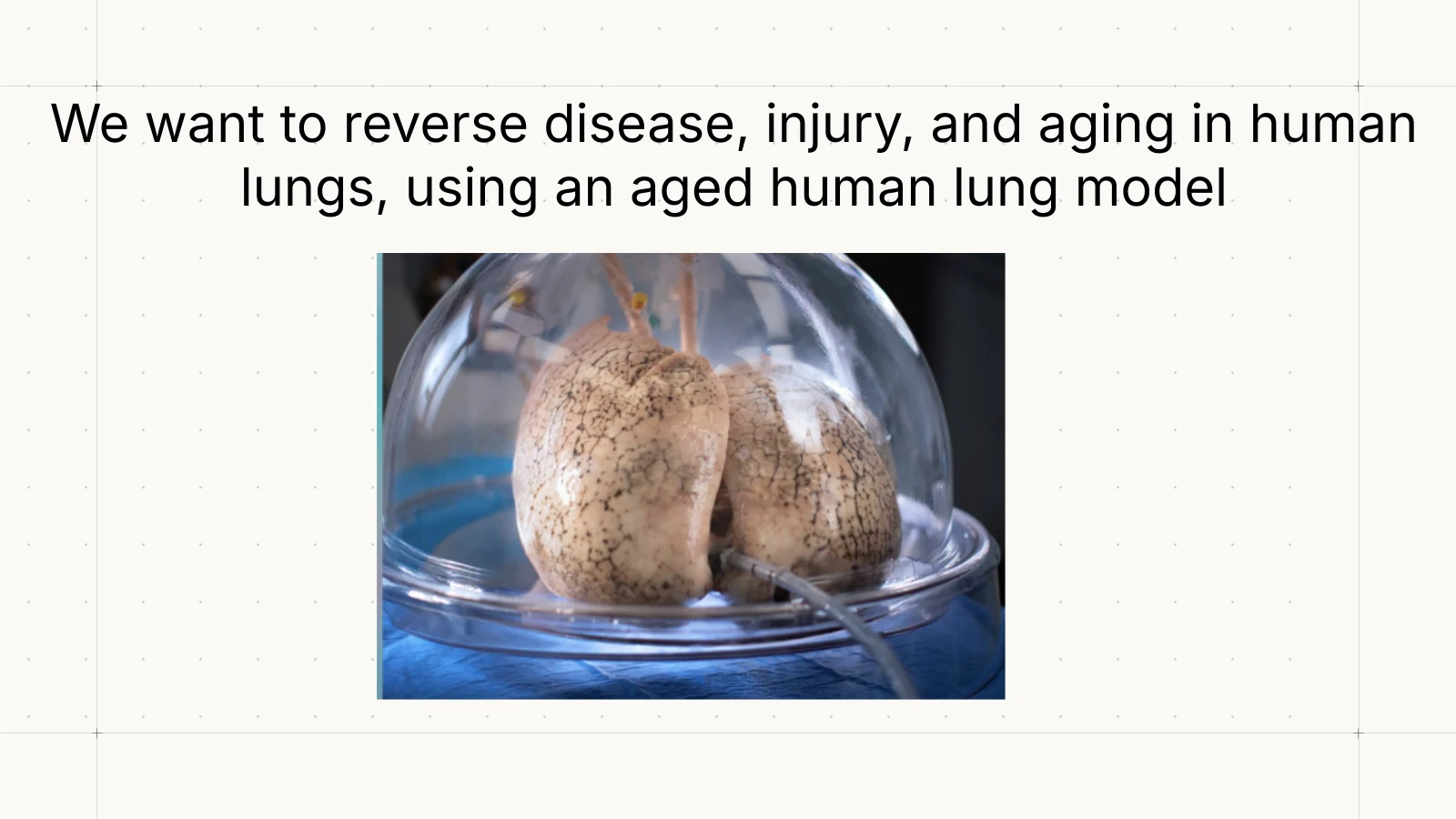
Her experimental model is a human lung rejected for transplantation, sustained outside the body by a perfusion machine. Age, injury and disease make these lungs useful for investigating whether interventions can reverse particular biological changes. Mucaj said researchers and transplant surgeons could test hundreds or even thousands of interventions together in a single lung, but her presentation put the search space at more than 43 quintillion possibilities.
The immediate application was ischemia-reperfusion injury, the injury associated with interruption and restoration of blood supply, which the candidate mRNAs are proposed to reduce during 12–24 hours of normothermic ex vivo lung perfusion. The team needed a shortlist justified by biology before committing scarce human organs to experiments.
Ten ranked candidates became an mRNA order for a lung experiment
- Researchers ordered mRNAs for a non-obvious combination. Using the Explorer, the scientists passed over the top-ranked combinations for a less-obvious option. Mucaj and the team have committed over $100,000 of experimental materials to validate the work in the lab. “Literally, as we speak, the mRNAs have been ordered, the lung experiments are being set up,” she said at Demo Day.
-
AI search produced a ranked top 10. Mucaj used AI agents to search biomedical literature and assembled a ranked list of 10 leading candidates and combinations among them, first packaged as a 24-page report.
-
AI found a retracted paper. In a Sept. 8 Slack message, Mucaj reported that AI had found a retracted paper the scientists might have missed, and the team was downgrading the candidate associated with it. Across several versions of the search, the top three candidates stayed consistent while explanations for lower-ranked ones varied.
-
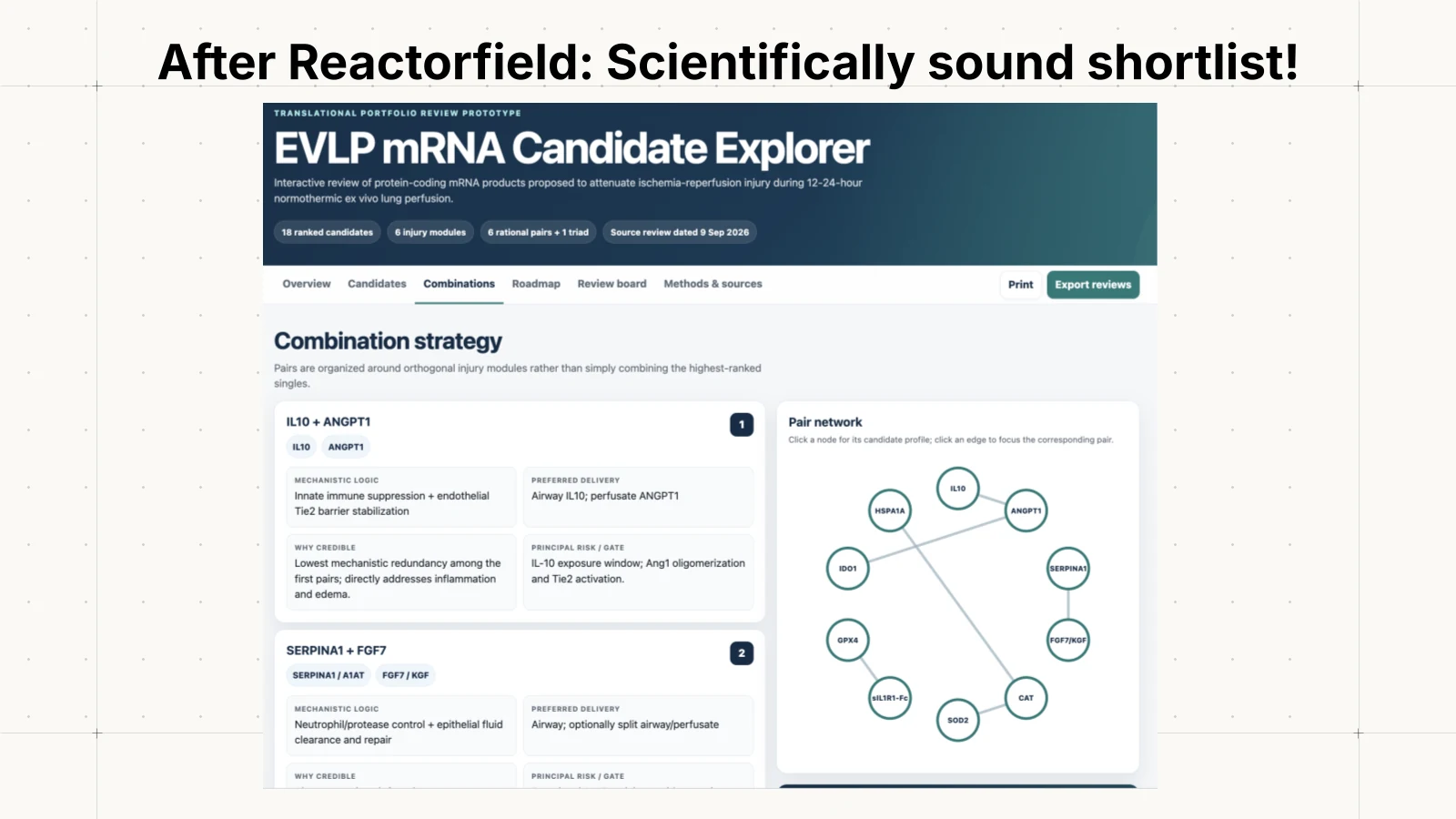
A first-time coder built the Explorer. A transplant surgeon just out of a 10-hour surgery had no time to read the report, so Mucaj, who said she had never coded or even held a GitHub account, built the EVLP mRNA Candidate Explorer. Reactorfield helped turn her HTML prototype into a hosted website the researchers could review together.
-
Pairs match complementary injury mechanisms. One proposed pair, IL10 and ANGPT1, joins suppression of innate immune activity with stabilization of the endothelial barrier through Tie2, proposing airway delivery for IL10 and delivery through the perfusate for ANGPT1. A second, SERPINA1 and FGF7, connects control of neutrophil and protease activity with epithelial fluid clearance and repair; both are mechanistic hypotheses for testing.
-
Familiar candidates built trust in the search. Her collaborators spent about 30 minutes exploring before selecting their next combination for the lab. During a Reactorfield Fellowship Office Hour, Mucaj said familiar, well-supported candidates reassured them the search could recover known biology, while the less-established combination offered a chance to produce new evidence.
-
The analysis ruled out one purchase. Researchers asked how four cytokines associated with the NF-κB pathway might behave together, and the literature-based analysis suggested some components would work against one another. The team decided against buying that combination, avoiding an experiment and its reagent cost, though the prediction did not establish antagonism in a lung.
-
Researchers asked to add unpublished data. Researcher feedback recorded on Mucaj’s Demo Day slide included “We picked a non-obvious combo from your list!” and “You also helped us decide what combos NOT to test,” plus a request: “Can I give you some unpublished data and see how the results change?” Mucaj began exploring that question with a manuscript supplied by the team.
Lung results will test the AI-derived hypotheses
The next result will come from comparing the chosen hypotheses with the lungs. As of October, the researchers are awaiting mRNA delivery. A next step would add the underlying lung data to test whether evidence from the perfused organ changes which combinations deserve priority.
Mucaj invited collaborators to test the evidence-review workflow against their own research questions and to work with the team on organ experiments, and she sought investors to help take the work to scale. At the Reactorfield Cohort 1 wrap-up, she said the program’s protected time and regular check-ins had forced her to prioritize a project she otherwise expected to keep postponing.