Developing U.S.-made magnets from recycled rare earths requires hours of image review
Matthew Groll is co-founder and chief technology officer of Mass Magnetics. He worked on thermal systems and guidance and navigation for the International Space Station and Artemis at NASA’s Johnson Space Center. Co-founder and chief executive Eric Silver brought a background in battery pilot production lines and materials-science laboratories for NSF-funded companies. The company joined Y Combinator’s summer 2026 batch and is based at Greentown Labs in Somerville, Massachusetts.
“America cannot make magnets,” Groll told the Demo Day audience. Magnets help turn electricity into motion in drones, robots and electric vehicles. Mass Magnetics is developing a route from recycled rare-earth material, including end-of-life motors, hard drives and industrial equipment, to U.S.-made permanent magnets for robotics and defense. Effective Jan. 1, 2027, the defense procurement clause DFARS 252.225-7052 expands restrictions on covered materials from specified countries to include mining, refining and separation. For neodymium-iron-boron magnets, it provides an exception for recycled material when milling and final sintering (heating compressed powder into a solid component) take place in the United States. That exception is the opening for Mass Magnetics.
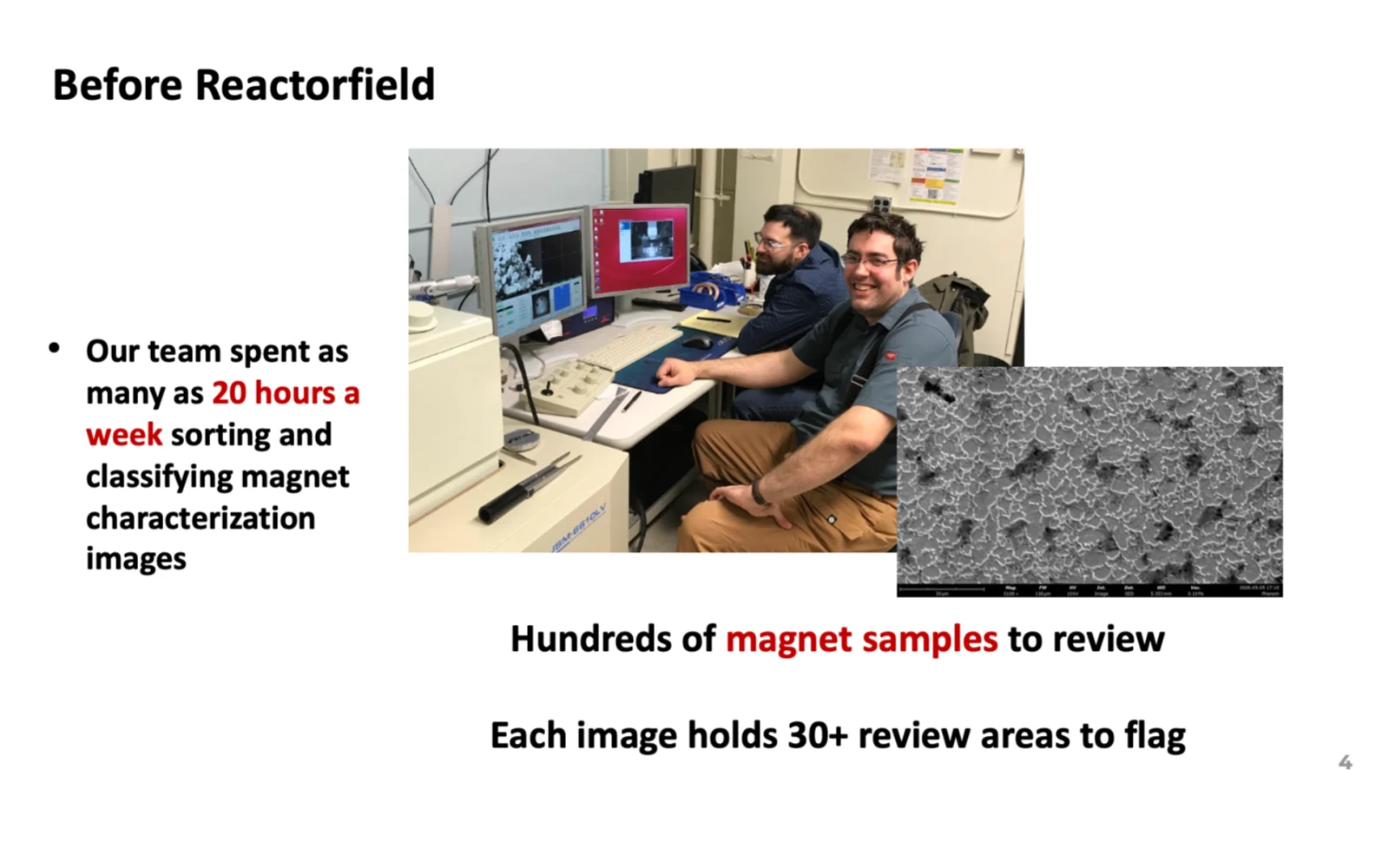
Groll said characterizing samples could consume as many as 20 hours in a week, with hundreds of samples to review and up to 30 areas to flag in an image; one tagging session could take four hours. Mass Magnetics brought the problem to Reactorfield’s first cohort, where the team set out to automate it with AI.
From mixed instrument files to a 15-minute defect review in four weeks
-
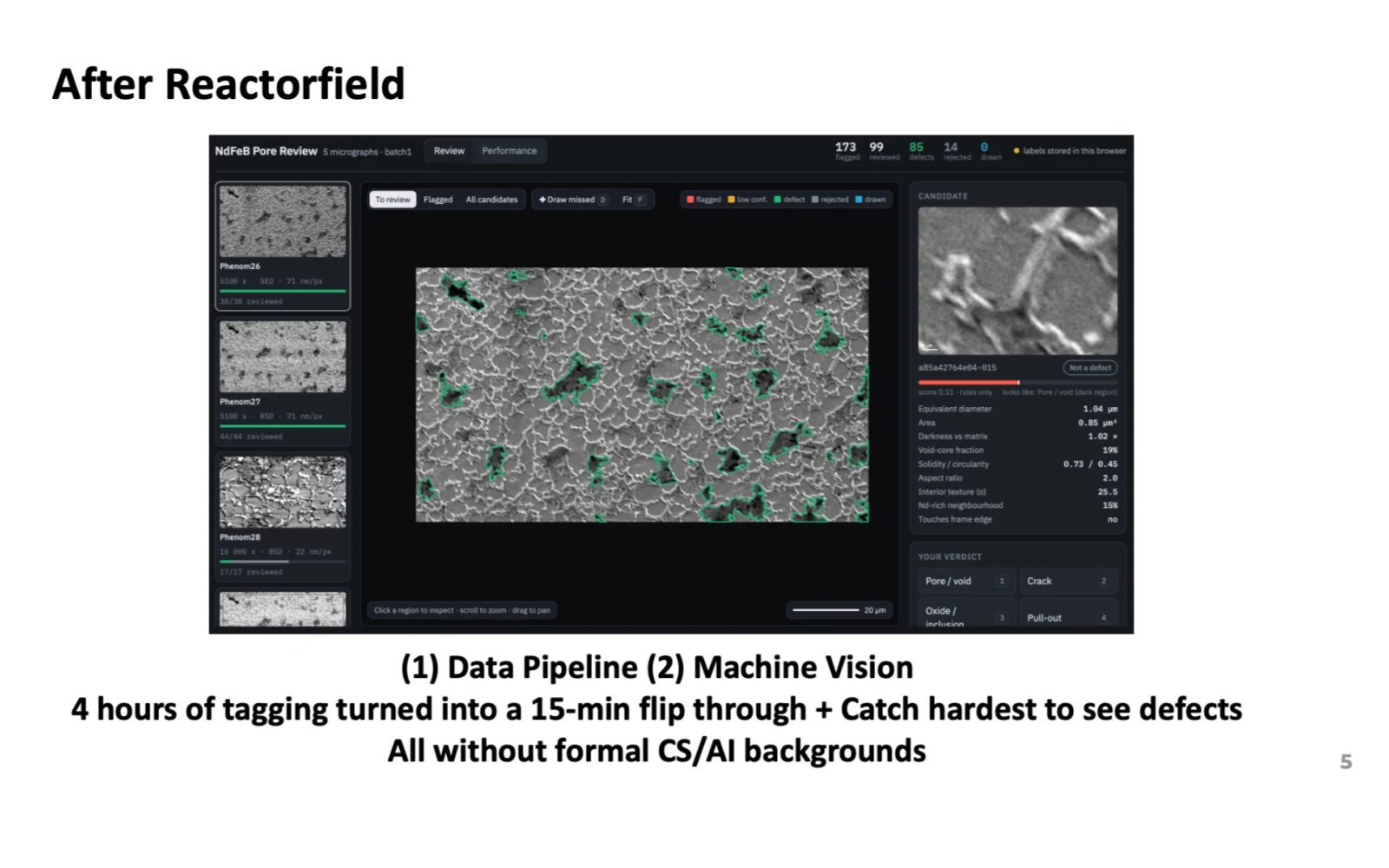
Tagging fell from four hours to just 15 minutes. The team’s machine-vision tool, which identifies defects and discolored regions, turned a tagging session that could take four hours into a 15-minute review, a 16-fold reduction. It also caught hard-to-see flaws that Groll said the team would otherwise miss with the human eye. A researcher still confirms each mark, and the team has not released a public accuracy benchmark.
-
The first target was automatic file sorting. During Reactorfield Office Hours, Groll and the Reactorfield team mapped out a web uploader that would recognize microscope images, elemental-analysis outputs and magnetometer measurements and sort them automatically instead of by hand.
-
Highlighting became the first vision milestone. Reactorfield’s technical guidance helped focus the work on AI that highlights likely defects for a human reviewer to confirm, with performance scoring as a later objective.
-
A vision tool labeled regions within about two weeks. By a Reactorfield group office hour midway through the cohort, the team had built it with Claude and open-source vision libraries; it selected regions in scanning-electron-microscope images and ignored scale bars and machine artifacts. Its first job was to flag when something had gone substantially wrong with a sample.
-
Instrument data moved into one pipeline. At Demo Day, Groll showed the second tool collecting inputs and measurements from different laboratory equipment into one stream, so each image can stay connected to the sample and measurements it describes.
- Reviewers now check marks instead of placing them. The NdFeB Pore Review interface outlines candidate regions in micrographs, or microscope images, of neodymium–iron–boron magnets and lists descriptors such as equivalent diameter, area and darkness relative to the surrounding material. The reviewer inspects an enlarged view of each region, assigns a category such as pore or void, crack, oxide or inclusion, or pull-out, and can draw a region the system missed.
What a predictive materials engine could mean for U.S.-made magnets
Groll’s next goal is what he called a “predictive materials engine,” which would connect composition and processing to magnet performance, grade and new material candidates. Reviewed micrographs and organized instrument records are its starting data; the next step is learning which features distinguish higher-performing material. The end goal is a feedback loop in which, in Groll’s words, “each experiment informs the next.”
The magnets are meant for robotics and defense buyers who need U.S.-made supply. Mass Magnetics sells recovered alloys while developing its own sintering capacity, and it accepts magnet preorders with delivery expected by year-end.
Rebuilding a U.S. magnet supply chain will take more than recycled feedstock and new sintering capacity; it also takes learning fast from every sample. Mass Magnetics showed that a hardware team without formal computer-science or AI backgrounds can build that capability itself, with AI, inside a four-week program. If the predictive engine works, the images that once cost a researcher an afternoon of tagging could help decide which magnet the team makes next.