Tracking competing in vivo CAR-T programs depended on one scientist
Strand Therapeutics is a clinical-stage, Boston-based MIT spinout developing programmable mRNA medicines for cancer and autoimmune diseases. In August 2025 it raised a $153 million Series B led by Kinnevik, bringing its total funding above $250 million. STX-005 is its circular mRNA program for in vivo CAR-T in autoimmune disease and blood cancers, an approach that delivers genetic instructions to immune cells inside a patient so those cells can recognize and attack a target; conventional CAR-T requires cells to be collected, engineered outside the body and returned. Strand has reported preclinical work generating functional CAR-T cells in humanized mice and non-human primates.
In vivo CAR-T is a novel modality pursued by many competing companies, and advancing STX-005 means comparing how those programs combine antigen targets, delivery systems and disease indications. Rio Boothello, a senior scientist in in vivo cell pharmacology, spent about five hours every week reading patents, publications and presentations and updating Strand’s working picture of the field. Directors and executives routed questions through him, so answers depended on when he could respond.
During Reactorfield’s four-week Cohort 1 program, Boothello and Dan Hartman, a senior engineer in machine learning and data analytics, used AI coding tools to build the external-research component of what the team calls a research engine. Together they turned Boothello’s recurring task into an application other people at Strand can use.
Strand scientists could query the evidence without waiting for Boothello
-
A five-hour weekly task was automated. At Demo Day, Hartman said the team had automated the entire five-hour manual curation task, and colleagues can now get source-backed answers in minutes. By removing the question queue that ran through Boothello, the team estimates it is saving Strand’s senior decision makers 35 hours per week.
-
The scientist prototyped his own interface. Boothello used Cursor to prototype the interface he wanted, while Hartman used Codex to build the dashboard. ClinicalTrials.gov updates run on a schedule alongside ingestion of publications and conference PDFs, and a review tab lets Boothello check new claims against the original evidence and resolve disagreements with earlier information.
-
Answers link back to their sources. The application brings findings together with their original sources, so a scientist can follow an answer back to the document behind it. A patent, a conference slide and an experimental paper carry different kinds of evidence, so keeping each answer tied to its source is part of the science.
-
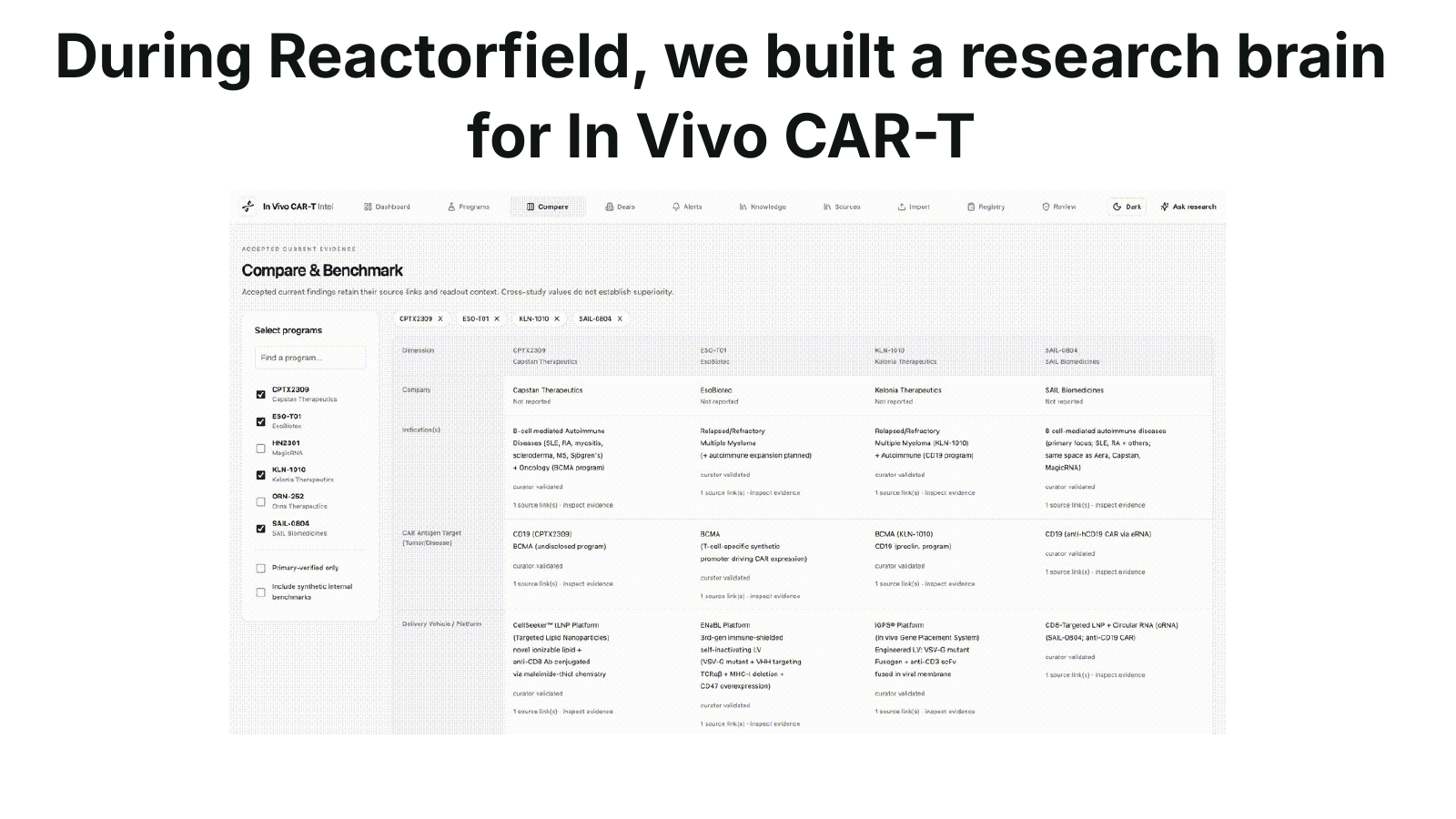
A comparison view put programs side by side. By the end of the program, the tool had a dashboard for the field, a comparison view across programs and a research view that answers from source-backed data while labeling inferences. The comparison view places disease indications, CAR antigen targets such as CD19 and BCMA, and delivery platforms such as targeted lipid nanoparticles and lentiviral systems alongside one another.
-
Strand’s key decision makers already have it. Strand released the first version to the people who make the final calls on the program’s next stage; it reached eight internal users and drew positive feedback. Automating collection gives Boothello a different job: judging the evidence that other scientists rely on.
-
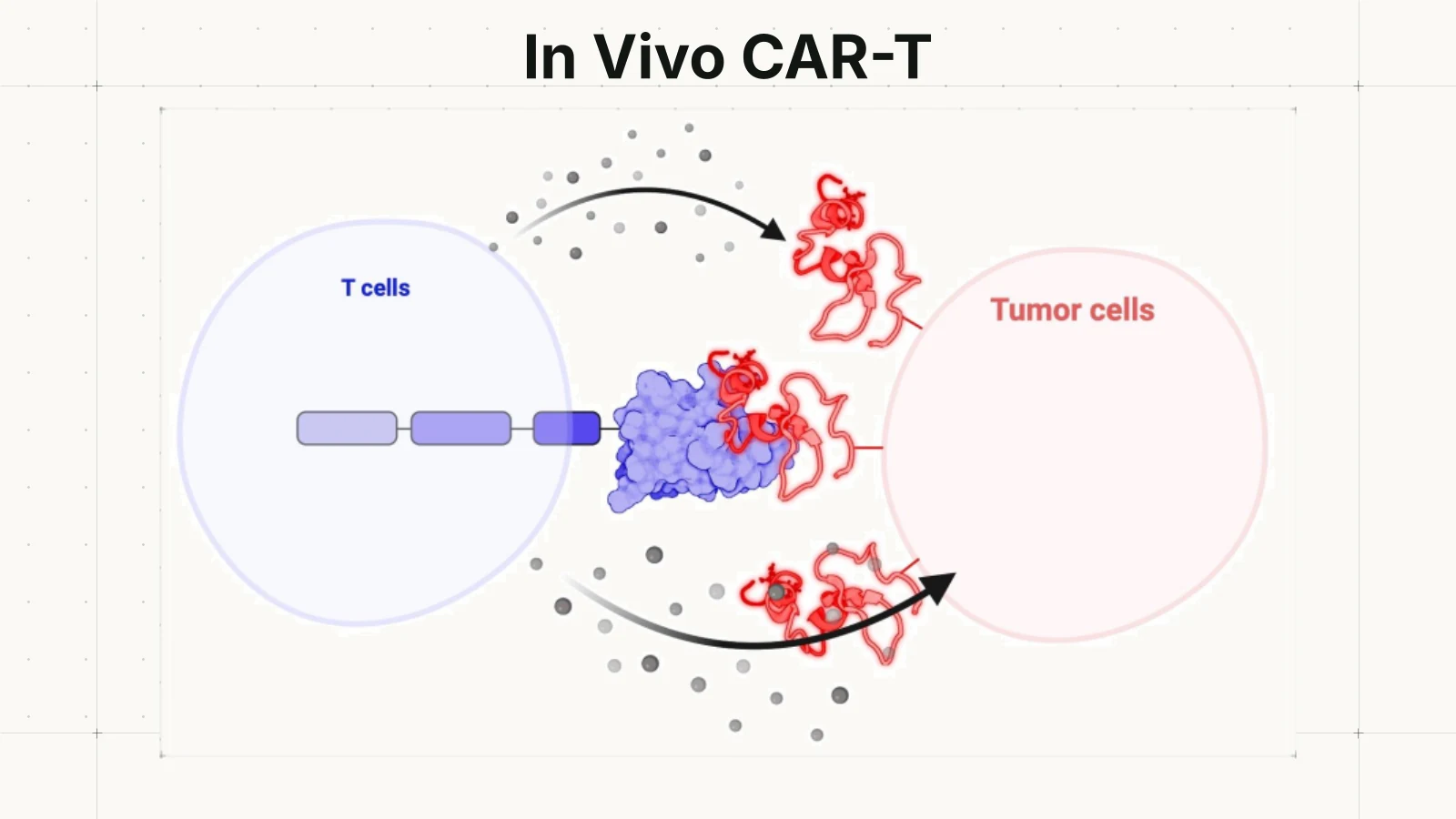
A four-hour wait became a direct question. Hartman’s example was an executive asking about an antigen that competing programs were targeting, and his slide illustrated a four-hour interval between a director’s inquiry and Boothello’s response. Now a colleague can ask the application directly and get a source-backed answer in minutes.
-
A co-founder endorsed the tool. The Demo Day presentation carried an endorsement from Tasuku Kitada, Strand’s co-founder and president of R&D: “This is a really great tool!”
-
Both fellows widened their AI use. At the Reactorfield Cohort 1 wrap-up, Boothello, who said he started the program as a beginner, described himself as AI native, now applying AI to graphs, reports and competitive research after Hartman introduced him to AI coding tools. Hartman moved to running several parallel AI coding sessions across projects after Reactorfield’s technical sessions, and called the program a four-week sprint that served as a forcing function for getting something done.
Next, a research brain that helps Strand design its experiments
Hartman proposed connecting Strand’s proprietary experimental data to the external evidence, then adding tools that assist with experimental design. Scientists would then have one place to examine published target-and-delivery combinations alongside their own results when designing the next set of experiments.
Hartman called the external research engine just the beginning. The larger idea is a research brain shared across the company: one place where published evidence, Strand’s own experiments and its scientists’ judgment come together to decide what to test next. In a novel modality with many competitors, the advantage goes to teams whose experts spend their hours judging evidence rather than collecting it, and whose decision makers get a sourced answer in minutes instead of waiting in a queue. Strand built the first piece of that in four weeks.