Masked immunotherapies depend on comparing many molecular variants
Oleg Yerov is a senior scientist at Xilio Therapeutics, a Waltham, Mass., company that trades on Nasdaq as $XLO. Xilio develops cancer immunotherapies designed to remain masked in circulation and become active in the tumor microenvironment, with the goal of focusing the immune response at the tumor and reducing systemic side effects. An AbbVie collaboration announced in February 2025 carried $52 million in upfront payments, including a $10 million equity investment, and provided for up to about $2.1 billion in contingent option fees and milestones. In August 2026, the FDA cleared Xilio’s IND for XTX501, a potential foundational backbone therapy for solid tumors, with a Phase 1/2 trial starting in the second half of 2026.
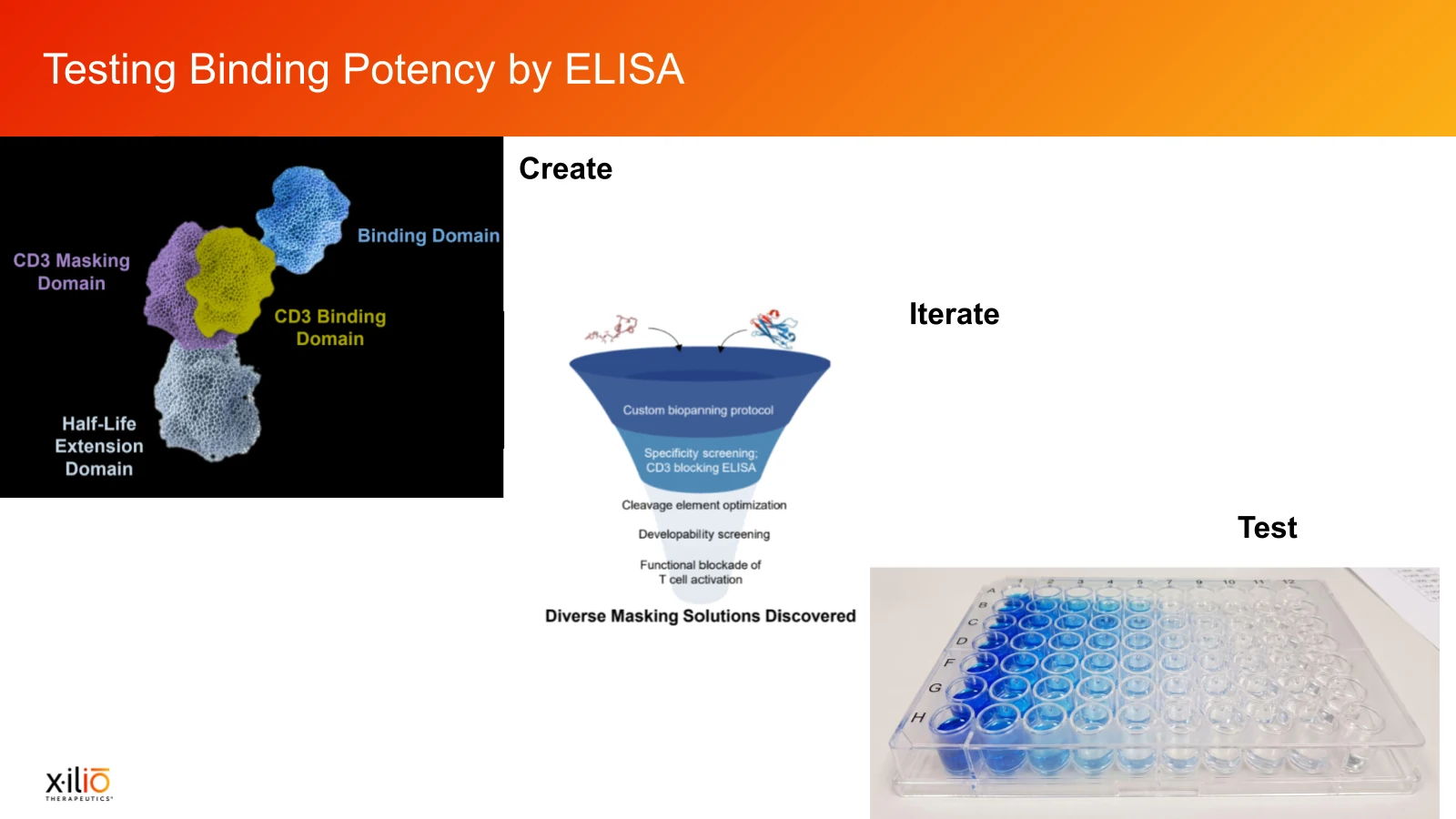
For its CD3-directed constructs, Xilio combines a CD3-binding domain, a masking domain, another binding domain and a domain that extends half-life. Each design round can produce many candidates. A team might make a hundred molecular variants and send them through testing, Yerov explained, and analyzing the data became the biggest bottleneck.
That analysis has to keep each signal measured in a plate well tied to the concentration tested and the molecular design that produced it. Without that link, a comparison cannot show which design features accompany a change in binding.
One app now carries binding data from notebook to report
-
A 25-minute workflow ran in 25 seconds. At Demo Day, Yerov showed a recording, running in real time, of the app producing its output in 25 seconds with more molecules than a manual example that took 25 minutes for four molecules. This was 60 times faster.
-
The first application handles ELISA binding data. The example tested binding potency by ELISA, a laboratory assay used here to compare how molecules bind. Xilio’s screening process for masked CD3-directed constructs examines CD3 blocking by ELISA, cleavage-element optimization, developability and functional blockade of T-cell activation.
-
A bench scientist used AI to build software. Yerov had 15 years of wet-lab experience and no prior software-engineering or coding experience, and described the project as his first substantial move into automation. With Reactorfield, he used AI to figure out how to approach the problem and build the app.
-
Colleague feedback shaped the design. Yerov summarized his approach as “build, not buy,” with software fitted to the way his Xilio colleagues already worked. He asked them what they needed help doing and thanked them for the feedback that shaped the app.
-
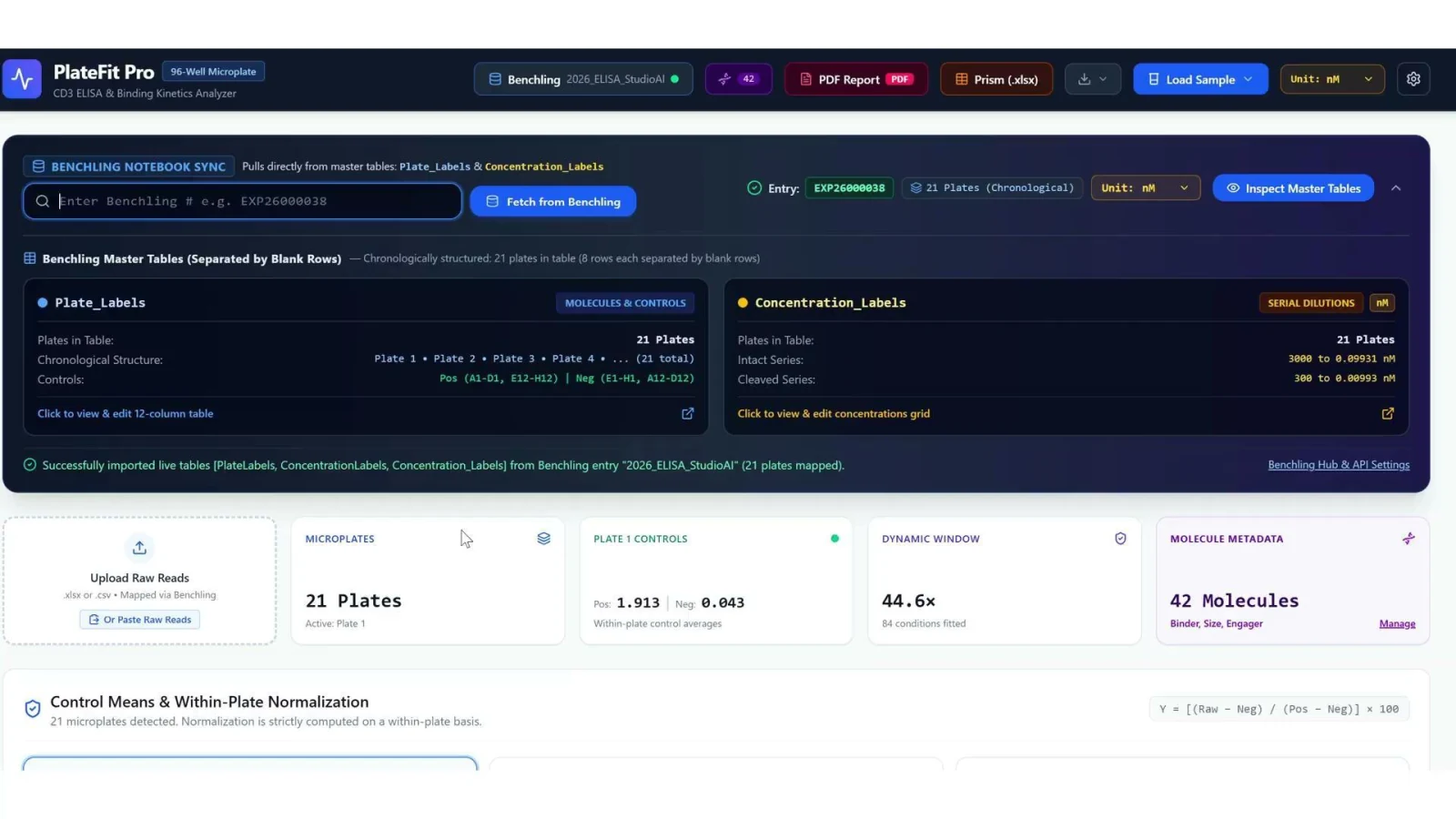
Notebook records now arrive through an API. Xilio’s internal tool fetches plate labels and concentration tables from Benchling through an API, a software connection, replacing the step in which labels were copied one at a time from the electronic laboratory notebook. The scientist pastes in raw readings and drags and drops molecular descriptions, and the interface keeps the imported tables and metadata such as binder, size and engager available for review.
-
Curves come out normalized and fitted. The app normalizes readings against positive and negative controls within each plate, then fits dose-response curves using four-parameter logistic regression, which expresses measurements across a concentration series as a curve researchers can compare across constructs. The report sets those curves beside categorical comparisons of molecular characteristics, in place of the manual route that ended with one graph on one PowerPoint slide.
-
Xilio already uses the app internally. It is built around work that up to 25 scientists repeat multiple times a week. The demonstrated gain covers data preparation and reporting; laboratory testing and biological interpretation remain separate tasks.
Standardized assay data may inform asset and experimental design
During a Reactorfield Cohort 1 wrap-up call, the Xilio team considered how to clean and standardize experimental data for machine learning, including predictions concerning new assets. Any such prediction would still have to prove itself at the bench: make the predicted designs, measure their behavior and compare the results with the predictions.
Yerov’s goal for the next year is to build as many of these apps for research workflows as he can. At Demo Day, he put the motivation in personal terms: “I want to amplify our scientists.” He wants colleagues to have more time to analyze their data, develop their skills and leave tedium behind to focus on the important work.
Yerov’s case is that Xilio’s science already works: the company is in the clinic with a big pipeline. What he wants to change is how much of each scientist’s week goes into moving data by hand. Fifteen years at the bench told him what to build; with Reactorfield, AI let him build it.